
Ever sat at a blackjack table or logged in to a casino and felt unsure what your winnings could be? You’re not alone. Understanding payouts and odds makes the game clearer and helps you make better choices while you play.
This guide explains the key payouts, how odds work, and what those numbers mean in pounds and pence, so you can follow the action with confidence. Read on to learn how different hands pay out, how the house edge affects returns and what typical in-game scenarios look like.
Understanding Blackjack Payouts Explained
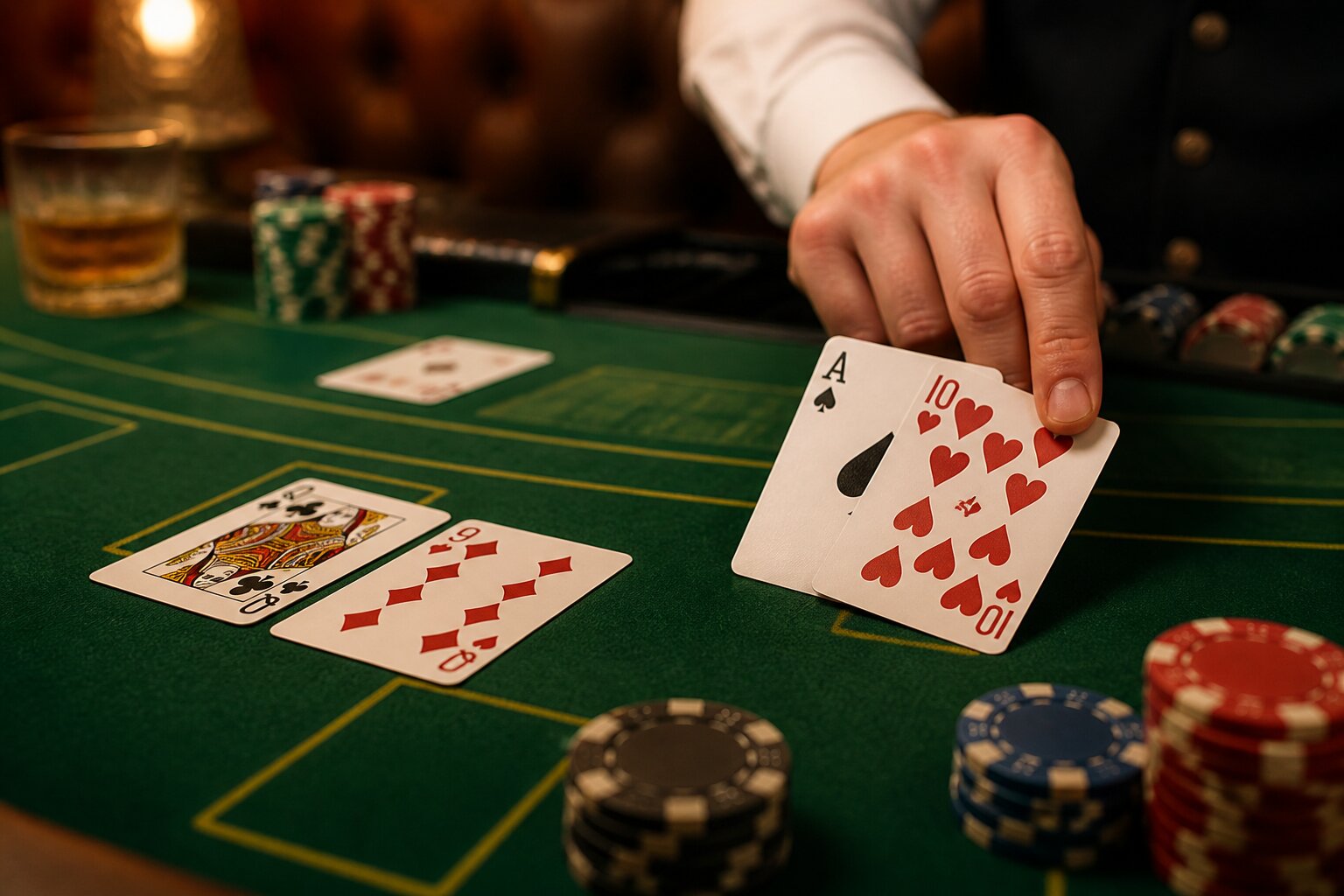
Blackjack payouts are the amounts you receive when a hand ends in your favour, calculated against the size of your original bet. The most important payout is for a natural blackjack: an Ace paired with any ten-value card as your first two cards.
A natural blackjack most commonly pays 3:2. On a £10 stake, that returns £15 in winnings plus your original £10 for a total of £25. Some games pay 6:5 for a blackjack, which gives £12 winnings on a £10 bet, totalling £22. Always check which payout ratio a table uses before you play, since the difference materially affects long-term returns.
A standard win that is not a blackjack pays 1:1, so a £10 win gives £10 in winnings plus the £10 stake, totalling £20. Insurance, offered when the dealer shows an Ace, is a separate side bet equal to half the original stake and pays 2:1 if the dealer has a blackjack. The insurance option is worth understanding because it changes the way individual hands can resolve.
With the payout landscape clear, the next section explains how odds shape your chances across many hands.
How Do Blackjack Odds Work?
Odds in blackjack express the probability of different outcomes across hands and are influenced by the number of decks, table rules and the decisions a player makes. For instance, the probability of receiving a natural blackjack from a freshly shuffled single deck is just under 5%.
Using basic strategy — the mathematically optimal set of decisions for each situation — typically places a player’s win rate in the roughly 42% to 49% range, while the dealer wins about 49% to 57% of hands. The remainder are pushes where the stake is returned. Small changes to rules or the number of decks shift these percentages, sometimes noticeably.
Card composition also matters. If more ten-value cards remain in the deck, the likelihood of strong hands increases. This variable nature is why outcomes over individual sessions vary, whereas odds describe expectations over many hands. Next, the article looks at the concrete ways a hand can finish and what each result pays.
Common Blackjack Hand Outcomes
Blackjack hands end in a few standard ways, each with a clear effect on your stake. A win occurs when your total is higher than the dealer’s without exceeding 21, or when the dealer busts after drawing too many cards. A push returns your original stake with no additional payout, and a bust — when your cards total more than 21 — results in an immediate loss of the stake for that hand.
A natural blackjack is the strongest outcome and normally earns the higher 3:2 payout described earlier. When both player and dealer have the same total, the push simply returns the stake so you move on to the next hand without winning or losing. Below are focused explanations of two common outcomes a player often asks about.
What Is the Payout for a Natural Blackjack?
A natural blackjack is formed by an Ace and any ten-value card as the opening two cards. With the usual 3:2 payout, a £10 stake returns £15 in winnings plus the original stake, totalling £25. Where a table pays 6:5, the same £10 stake returns £12 in winnings, totalling £22. The payout structure you choose to play under has a direct effect on expected returns over time.
What Happens in a Push or Tie?
A push occurs when both the player and dealer finish with the same hand value, commonly between 17 and 21. In that case the stake is returned in full, and neither side gains a payout. This outcome keeps individual session variance lower than a straight win-or-lose format and can influence how a player thinks about risk across successive hands.
With outcomes and payouts understood, it helps to see how the casino’s built-in advantage interacts with these figures.
How House Edge Affects Player Returns
The house edge is the percentage of each bet the casino expects to retain over the long run. With standard rules and a 3:2 blackjack payout, following basic strategy typically results in a house edge around 0.5%. That means a long-term expected cost of about 50p for every £100 wagered. If blackjack pays 6:5 instead, the house edge rises and may be around 1.5% or more, increasing the expected cost to about £1.50 per £100 staked.
Other rule variations alter the edge in smaller ways. Allowing doubling after splitting and the dealer standing on soft 17 generally reduce the house edge, while removing those options or offering poorer blackjack payouts raises it. Because the house edge represents a long-term expectation, it should inform choices about which tables and rules to play under.
Next, the article compares single-deck and multi-deck games to show how the number of decks affects those same expectations.
Differences Between Single Deck & Multi-Deck Blackjack Odds
The number of decks in play changes the probabilities of particular card combinations and therefore the house edge. Single-deck games typically offer the best odds for players under favourable rules, with a house edge that can be as low as about 0.15% in ideal conditions. That advantage comes from the greater relative frequency of naturals and the easier ability to track card composition.
As decks increase to six or eight, the house edge commonly rises to around 0.5% to 0.7% under comparable rules. Multiple decks reduce the chances of some player-beneficial outcomes and make card composition harder to infer. Rule changes interact with deck count too; for example, allowing doubling after splitting reduces the penalty of multiple decks, while poorer blackjack payouts amplify it.
Understanding the deck effect makes it easier to choose which games to favour, and the next section shows these ideas in practical scenarios.
Examples of Typical Blackjack Scenarios
Below are common in-play examples that illustrate how outcomes, payouts and rules combine in real hands. Each scenario uses a £10 stake to show the monetary impact clearly.
Scenario 1: Player Wins with a Higher Hand
You have a 9 and an 8 for 17. The dealer ends with 18. Your £10 stake is lost because the dealer’s total is higher.
Scenario 2: Player Gets a Natural Blackjack
You receive an Ace and a King, totalling 21. With a 3:2 payout on a £10 bet, you receive £15 winnings plus the £10 stake, totalling £25.
Scenario 3: Dealer Busts
You hold a 10 and 7 for a total of 17. The dealer draws beyond 21 and busts. Your £10 stake wins at 1:1, returning £10 winnings plus your stake for a total of £20.
Scenario 4: Push/Tie
Both you and the dealer finish on 20. Your original £10 stake is returned, with no winnings.
Scenario 5: Player Busts
You draw into 23 and bust. Your £10 stake is lost immediately regardless of how the dealer’s hand plays out.
These examples show the direct relationship between hand outcomes and money returned. Knowing how different hands resolve and how payouts are calculated helps you follow the game with greater clarity and select tables and rules that align with your preferences. With that understanding, you can enjoy playing while staying aware of how odds and payouts will affect your session overall.
Play Casino Games Online at Pay By Mobile Slots
We invite you to enjoy a friendly and welcoming place to play casino games with us. Take things at your own pace and make the most of your experience, however you prefer. you are ready to play. We look forward to seeing you with us soon.
**The information provided in this blog is intended for educational purposes and should not be construed as betting advice or a guarantee of success. Always gamble responsibly.