
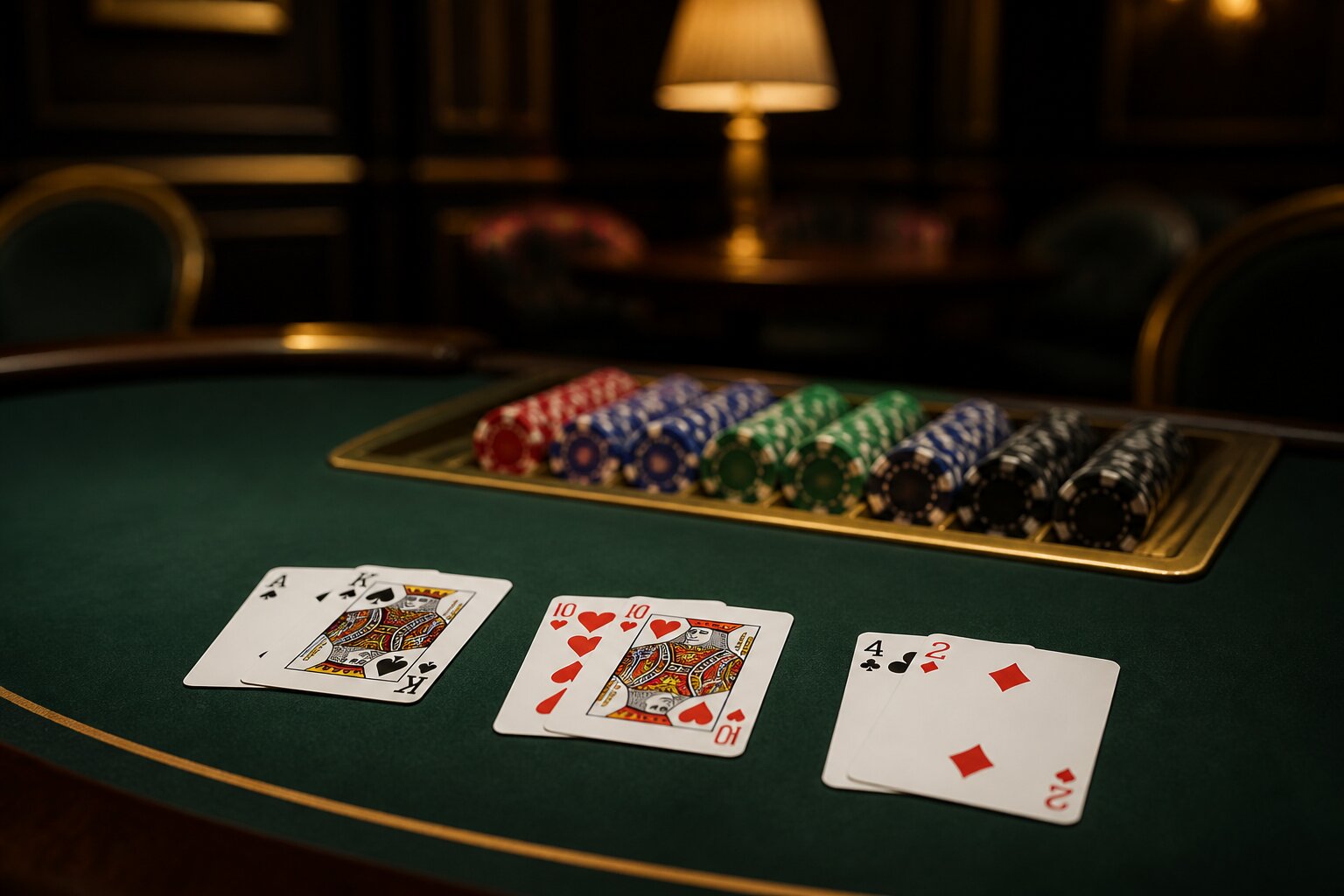
Blackjack is a game of quick decisions and strategy, and everything starts with the hand you’re dealt. Ever wondered which hands give you the best shot at a win and which ones can leave you in a tight spot?
Whether you’re new to the game or brushing up, understanding the most powerful hands and the trickier combinations helps you play with more confidence and clarity. Read on to see which hands matter most and how each combination shapes what you do next.
What Are the Key Hand Rankings in Blackjack?
Blackjack hand rankings are based on the numerical total of the cards in your hand, with the aim of getting as close to 21 as possible without exceeding it. Number cards (2–10) count at face value. Face cards—Jack, Queen and King—each count as 10. The Ace is flexible: it can be worth 1 or 11, depending on what best suits the hand.
The single strongest outcome from the first two cards is an Ace plus any 10-value card, which is called a natural blackjack and is treated differently from a 21 made with more cards. Other high-value hands are totals of 21 reached with three or more cards; they are strong but do not qualify as naturals.
Key hand ranking terms include:
- Blackjack: Ace plus a 10-value card (for example, Ace of Hearts and King of Spades)
- 21: Any combination of cards totalling 21 (for example, 7 + 6 + 8)
- Hard 17: A hand totalling 17 with no Ace counted as 11 (for example, 10 + 7)
- Soft 18: A hand totalling 18 with an Ace counted as 11 (for example, Ace + 7)
- Bust: Any hand over 21, which results in an automatic loss
These terms describe the relative strength of hands and the choices those hands typically demand at the table. Next, we’ll look at the hands that offer the clearest advantage and why they matter.
The Most Valuable Blackjack Hands
High-value hands put you closest to 21 without breaking it, and they often let you play with more flexibility. A strong starting total reduces the pressure on later decisions and gives you better prospect of winning that round.
A natural blackjack is the highest-ranking hand. It consists of an Ace and a 10-value card dealt as your first two cards. This hand is unbeatable except when the dealer also has a blackjack, which results in a push. It usually pays out at better odds than a standard win and appears with some regularity in multi-deck play.
Strong non-natural hands include totals of 20 and 19. Two 10-value cards make a hard 20, a simple but powerful holding. An Ace paired with a 9 forms a soft 20, which retains flexibility because the Ace can fall back to a value of 1 if you draw another card. These totals are statistically robust and generally require little further action, though decisions can still be influenced by the dealer’s visible card and table rules.
Understanding why these hands rank highly helps when you move on to see how mid-range hands behave and where the tougher choices lie.
Natural Blackjack: What Is It and Why Is It Special?
A natural blackjack, an Ace plus a 10-value card as the first two cards, stands apart because of how it is settled. It beats all regular hands and typically receives a higher payout than a standard win. If both player and dealer have a natural, the result is a push and the stake is returned. In common multi-deck games, naturals occur at a measurable rate, which is why they are such an important part of overall strategy and bankroll expectations.
This special status is important because the presence of a natural affects not just the round in which it appears but also how players view risk and reward across a session. After this, it is useful to consider other strong hands and their practical value.
Strong Hands: Which Combinations Give You an Edge?
Hands totalling 20 or 19 are particularly valuable because they defend well against most dealer outcomes. A hard 20 is difficult for the dealer to beat without hitting 21, while soft hands of the same numerical value keep options open. For example, a soft 19 lets a player adjust if later cards would otherwise force them into a poor position.
These hands also influence how players manage their stakes and when they choose to be conservative. Recognising when your total is strong enough to stand, and when table rules or the dealer’s card might change that, is a subtle but meaningful part of deciding how aggressively to press your advantage.
Common Hands and Typical Values
Most hands you encounter will be mid-range totals rather than naturals or near-21 holdings. These carry the bulk of the game’s practical decisions, and playing them well is where technique makes the biggest difference.
Mid-range hands often require weighing the risk of busting against the chance of improving. As totals rise, the margin for safe action narrows, and understanding the distinction between hard and soft hands becomes crucial.
Hard Hands vs Soft Hands: What’s the Difference?
A hard hand is one where an Ace is counted as 1, or where there is no Ace at all. This type of hand has fixed value and less flexibility when drawing additional cards. For example, a hard 17 is commonly made from a 10 and a 7 and usually discourages further hits because the risk of exceeding 21 is high.
A soft hand includes an Ace counted as 11, which creates a buffer: the Ace can revert to 1 if taking another card would otherwise cause a bust. An Ace plus a 6 is a soft 17; this can be played more aggressively because it carries less immediate risk. The different treatment of Aces is fundamental to how many hands are played, especially in marginal situations.
These differences set the stage for understanding which hands are most troublesome and why some totals are commonly labelled as the least favourable.
Hands to Watch: Valuable But Risky Combinations
Totals between 12 and 16 are often called the danger zone because they present a difficult trade-off. Standing on these hands frequently loses to the dealer’s higher totals, yet hitting risks busting. A hard 16, for example, is notorious for being hard to play well in many dealer scenarios.
Knowing how to approach these hands involves looking at the dealer’s visible card and considering the statistical chances of improvement versus bust. Those judgement calls are central to maintaining control over a session and keeping decisions within personal comfort levels. With that in mind, the next section focuses on the specific hands that players generally find most unfavourable.
Which Blackjack Hands Are Considered the Least Favourable?
Certain totals leave a player in a particularly uncomfortable position between a high chance of losing and a high chance of busting if they try to improve. The most common examples are hard 15 and hard 16.
A hard 16, such as a 10 and 6, becomes especially awkward when the dealer shows a strong upcard like a 10 or an Ace. Standing tends to lose against those dealer totals, but hitting is likely to send the player over 21. Hard 15 presents a similar dilemma, with only slightly better prospects for improvement and the same risk of busting.
Low totals under 12 are also problematic when matched against a dealer’s strong upcard because those hands must hit to have a chance, yet they rarely reach a competitive total without help. Soft hands can mitigate some of that pressure, but when a hand is small and the dealer looks poised, the balance of probabilities is unfavourable.
Understanding which hands are least favourable helps inform how boldly or cautiously to play elsewhere in a session, and it naturally leads into how hand values shape the overall playing experience.
How Do Hand Values Impact Your Blackjack Experience?
Hand values determine the nature of decisions at every stage of play. A high total such as 20 or a natural blackjack tends to reduce the need for risky choices, while awkward totals create tension and require clearer judgement about whether to accept risk.
Ace’s flexibility lowers the immediate penalty for drawing. This adaptability can make play more engaging by keeping choices open and meaningful. In contrast, hard hands narrow options and place a premium on careful assessment of the dealer’s position.
Across a session, these fluctuations in hand value are what make the game strategically interesting. Approaching play with an awareness of how different totals change the decision landscape helps keep the experience enjoyable and within personal limits.
This wraps up the key combinations and how they influence play, giving a clear picture of which hands to welcome, which to watch closely, and how values shape decisions at the table.
Enjoy Casino Entertainment at Pay By Mobile Slots
At Pay By Mobile Slots, everyone is welcome to explore our relaxed casino setting and play in a way that suits them. We’re here to offer a friendly and straightforward experience whenever you’d like to join us.
Getting set up is easy—just create your account, make a deposit, and you’re all set to play. We look forward to seeing you online soon.
**The information provided in this blog is intended for educational purposes and should not be construed as betting advice or a guarantee of success. Always gamble responsibly.