
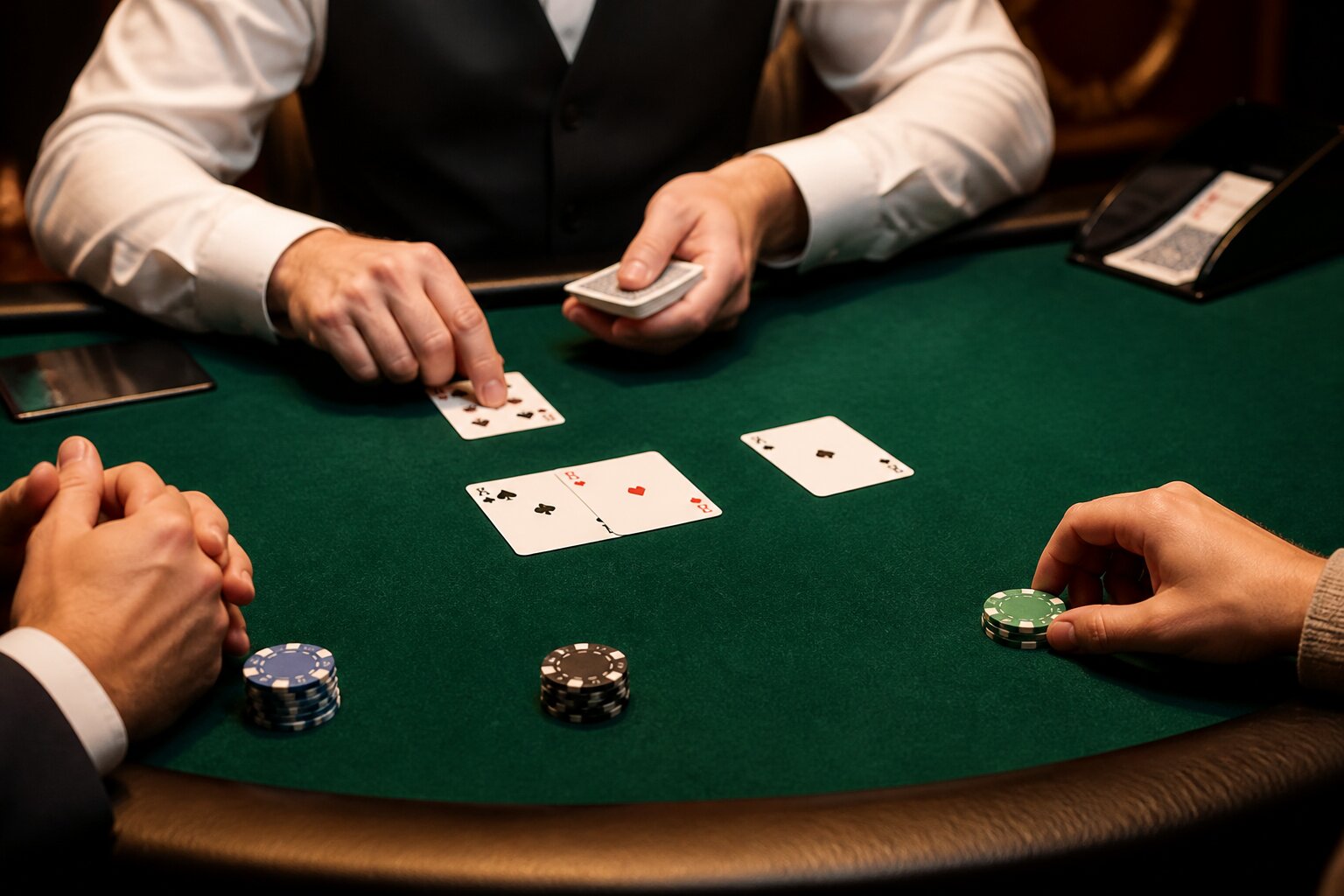
There’s something instantly exciting about the sound of cards being dealt at a casino table, and few games hold attention like blackjack. Maybe you’ve watched others racking up chips and wondered how they decide when to twist, stick or split, or perhaps you simply want to learn a classic game that balances clear rules with meaningful choices.
Blackjack has been popular in British casinos for generations because the basics are quick to learn. With a bit of practice you’ll recognise common situations at the table and feel more confident about the decisions you make.
Knowing the key steps before you play keeps the experience enjoyable rather than confusing. Read on to learn how a hand unfolds and what each decision means for your chances in a round.
What Is Blackjack & How Is It Played?
Blackjack, also called 21, centres on building a hand total as close to 21 as possible without going over. Each player and the dealer receive two cards and play is against the dealer rather than other players at the table.
Card values are straightforward: number cards count at face value, face cards (Jack, Queen, King) are worth 10, and an Ace can count as either 1 or 11 to best suit the hand. If the cards you hold add up to more than 21, that hand is bust and the stake for that round is lost.
When an Ace and any 10-value card appear together as the initial two cards, that is blackjack —the strongest possible hand and normally paid out ahead of regular wins. Rounds move quickly but each presents a small set of meaningful choices, which is what keeps the game interesting.
The Main Blackjack Rules Explained
Blackjack follows a compact set of rules that govern play for every round. Understanding these basics makes the rest of the game easier to follow.
Each player and the dealer receive two cards. Players’ cards are usually dealt face up; the dealer has one card face up and one face down (the hidden card).
Number cards count for their face value. Face cards (Jack, Queen, King) are worth 10. Aces can count as either 1 or 11, whichever best suits the hand.
After the deal, players take turns deciding whether to twist (take another card) or stick (end their turn). Players may continue to twist while their hand total remains under 21.
If a player’s total exceeds 21, that hand is bust and the bet is lost.
An Ace and a 10-value card dealt as the initial two cards is blackjack — the top hand.
When two cards of the same value are dealt, players often have the option to split them into two separate hands, placing a matching bet for the new hand.
The dealer reveals their hidden card after all players have finished. Standard practice is that the dealer must draw on 16 or less and stand on 17 or more.
Winning hands are those that exceed the dealer’s total without going over 21. Equal totals result in a push, with the stake returned to the player.
These rules provide a consistent framework so players can anticipate how a round will play out. Next, we’ll follow a typical hand from bet to reveal to see those rules in action.
Step-by-Step Guide: How to Play a Hand of Blackjack
Play begins by placing a bet within the table limits. Once bets are set, the dealer deals two cards to each player and two to themselves — one of the dealer’s cards remains hidden.
After looking at the two cards, you assess your position. Suppose you are dealt a 7 and a 10 for a total of 17: many players would stand on that total. With a total of 11, for example from a 5 and a 6, the hand is in a good position to take another card or consider doubling. If the initial two cards are a pair — say two 8s — splitting creates two hands, each with its own bet and potential outcome.
When all players have completed their turns, the dealer reveals the hole card and draws additional cards as required by the house rule (usually until reaching at least 17). If the dealer busts, remaining players win. Otherwise, each player’s total is compared to the dealer’s to determine wins, losses or pushes.
Every new deal resets the table, so each round is a fresh chance to apply experience and judgement. The next section clarifies how card values determine those totals and affect decisions.
Card Values & Types in Blackjack
Knowing how each card contributes to a hand is essential for scoring and choosing actions. Suits do not affect gameplay — only the number or face matters.
Here’s how card values work:
Card Type — Value — Example
- Number cards (2–10): Face value — 5 of Hearts = 5; 9 of Spades = 9
- Face cards (J, Q, K): 10 — King of Clubs = 10; Jack of Diamonds = 10
- Ace: 1 or 11 — Ace + 9 = 10 or 20; Ace + King = 11 + 10 = 21 (blackjack)
Number cards add predictably to your total, while face cards count as ten each. The Ace’s flexibility—counting as 1 or 11 as needed—creates the most strategic value, allowing hands to be soft (where an Ace can change value without busting) or hard.
Understanding these values makes the choice to twist, stick, split or double far clearer when you next face a decision at the table.
Essential Actions: What Choices Can Players Make?
During a hand you will use a small set of actions that define how your cards are played. Each option carries different consequences and is best used in particular scenarios.
What Does 'Hit', 'Stand', 'Double', or 'Split' Mean?
Hit
Taking another card from the dealer. For a hand totalling 12, a hit is often chosen to try to improve the total.
Stand
Keeping the current total and ending the turn. A player with 18 often stands rather than risk going over 21.
Double
Doubling is an opportunistic move when the odds of a single strong card are favourable. Players commonly double on totals of 10 or 11 to chase a strong single-card improvement.
Split
If the first two cards are identical in value, splitting separates them into two independent hands, each with its own stake.
When Should Each Option Be Used?
A hit suits lower totals where further improvement is needed. Standing is a defensive choice for totals that are likely to beat the dealer. Doubling is an opportunistic move when the odds of a single strong card are favourable. Splitting can turn a weak pair into two viable hands, though it also doubles exposure.
Decisions are shaped by the composition of the hand and the dealer’s exposed card; appreciating this relationship helps make each action a considered choice rather than a guess. With that in mind, the next section explains how the dealer’s fixed routine interacts with players’ choices.
Understanding the Dealer’s Role in Blackjack
The dealer operates under fixed rules rather than personal judgement, which gives players a stable reference for their own decisions. The dealer deals, holds a hidden card until players finish, and then plays their hand according to the house rule: draw to 16, stand on 17 and above in most games.
Because the dealer cannot split, double or otherwise vary play, their behaviour is predictable. When the dealer must draw until at least 17, for example, players can judge whether a modest total is likely to win or whether pressing for more value makes sense.
The dealer’s role creates a clear opponent dynamic: players use judgement and optional actions while the dealer follows a mechanical routine. Knowing this balance helps when deciding whether to be bold or cautious in a hand, and it sets the scene for managing your play over a session.
Tips for a Smooth Blackjack Experience
Set a clear budget before playing and stick to it. Having predefined limits keeps decisions straightforward and prevents stakes from creeping up during a session.
Take regular breaks to keep concentration sharp; fatigue can make small errors more likely. Short pauses also give time to reassess strategy and table conditions.
Use available account tools to control session length and spending. Many operators provide deposit and loss limits, and taking advantage of these features helps maintain a controlled approach.
Focus on enjoying the process of making informed decisions rather than expecting a specific outcome. If the game is no longer enjoyable, step away and seek support from independent organisations if needed.
Keeping play controlled and thoughtful will make blackjack a clearer, more enjoyable experience every time you sit down to a table.
Enjoy Casino Games at Pay By Mobile Slots
Fancy discovering a new way to enjoy your favourite pastime? We offer a friendly, welcoming space for anyone who enjoys the fun and excitement of casino games.
Getting started is simple: just create an account, make a deposit and you’re ready to explore the world of entertainment we have in store. We look forward to seeing you play with us.
**The information provided in this blog is intended for educational purposes and should not be construed as betting advice or a guarantee of success. Always gamble responsibly.