
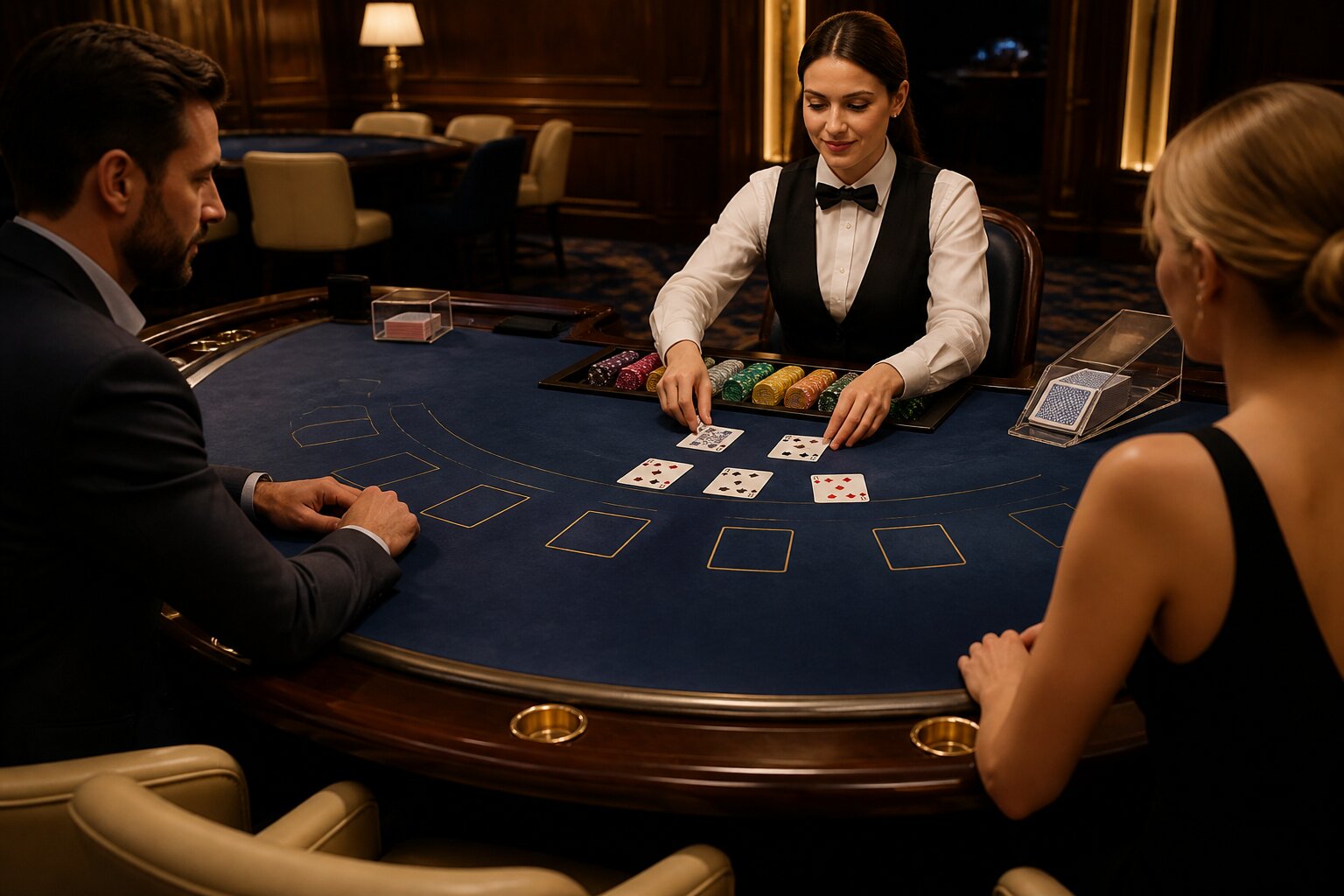
Ever wondered whether seating at a blackjack table matters? You’re not alone. Blackjack involves more than basic moves; the layout of the table and each seat’s role can shape the rhythm of play.
This concise guide explains what the anchor seat is, why it draws attention, and how table positions are organised so you know what to expect next time you sit down. Read on to find out which seat might suit you best and how the table’s flow works.
Ready to learn where the anchor sits and why players talk about it? Let’s get started.
What Does the Anchor Seat Mean in Blackjack?
The anchor seat refers to the final player position that acts before the dealer completes their hand. At a typical semi-circular table, it’s the last seat on the player side nearest the dealer’s right.
Being the last to play means you make your choice after everyone else at the table has acted. That timing can feel significant because you see other players’ actions before deciding on hit, stand, split or double down. Still, the anchor carries no extra rules or formal duties — it’s simply a way to describe that particular position.
This position often draws attention because it naturally falls into a closing role in the round, but in practice you follow the same procedures as other players and your hand is resolved under identical rules.
Why Is the Anchor Seat Considered Important?
The anchor seat is often highlighted because of its position in the order of play. Players sometimes attribute greater influence to its choices since those decisions come last before the dealer’s turn, and that can create pressure or heightened scrutiny from others at the table.
In reality, the importance is largely psychological. The anchor sees the table’s earlier play and may respond differently to that context, but the dealing and rules remain impartial to seating. Where embarrassment or debate might arise is in visible moments — for example, when a late player’s decision appears to change the table’s dynamic — not because the seat confers any procedural advantage.
If you find the attention uncomfortable, a different seat may feel better. If you enjoy seeing more of the table’s action before deciding, the anchor can be an attractive choice.
How Are Blackjack Table Positions Numbered?
Seating is numbered to help dealers manage the game efficiently. Numbering typically starts at the dealer’s immediate left and increases across the table, with the last seat — the anchor — carrying the highest number. On many tables this will be Seat 6 or Seat 7, depending on how many players the layout accommodates.
Numbers simplify bet settlement and dealer announcements, and they make it easier for staff to refer to specific positions when necessary. Beyond that organisational purpose, the numbers don’t alter how hands are dealt or resolved.
If you’re choosing where to sit, use the numbering as a quick guide to find the anchor or any other spot you prefer, but remember the numbers are administrative rather than strategic.
Where Is the Anchor Seat Located at the Table?
Visually, the anchor sits at the far end of the player arc, closest to the dealer’s right hand and just before the shoe or dealing position. From the player’s viewpoint it will be the last seat on the left.
When you approach a table, a quick count from the dealer’s left will show you which seat is the anchor. Its proximity to the shoe and to the dealer’s workspace makes it an easy reference point for players and staff alike.
Choosing that seat is primarily down to preference: some players like the perspective offered by being last to act, others prefer a different spot. Either way, the seat is open to anyone when available.
Does the Anchor Position Impact the Game?
No seating position changes the rules or the fairness of play. All hands are governed by the same regulations and the cards are dealt in the established manner irrespective of where players sit. The anchor’s late decision does not alter the underlying mechanics of card distribution or the dealer’s obligations.
What can vary is the table dynamic. Being last to act gives extra context about how other players have played their hands, and that information can affect a player’s choice in that moment. But that is a matter of visible information, not of altered probability or rule advantage.
If you want to avoid being observed making decisions, choose a different seat; if you prefer the extra context, the anchor delivers that naturally.
Common Myths About the Anchor Seat in Blackjack
There are a few recurring misconceptions about the anchor seat that tend to circulate among players. Clarifying them helps keep expectations realistic and prevents needless superstition during play.
Myth 1: The Anchor Controls the Game’s Outcome
This is a misunderstanding of sequence versus influence. The anchor acts last among players, but the order of play has no bearing on how the deck is prepared or how the dealer must play their hand. The rules of the game and the house procedures determine outcomes, not where a player sits.
The practical effect of acting last is simply that the anchor makes decisions after seeing more of what others have done. That may feel influential, but it does not change the underlying probabilities or the established house edge.
Myth 2: The Anchor Is Better or Worse for Winning
No seat confers a better statistical position. Every player faces the same conditions in terms of rules, dealing procedures and the dealer’s obligations. Any run of favourable or unfavourable results from a particular seat is most commonly a short-term fluctuation rather than evidence of a seat-based advantage.
Players who notice patterns are usually experiencing normal variance. Over many hands, results will move towards the expected probabilities dictated by the rules and the shoe.
Myth 3: Only Experienced Players Should Take the Anchor
There’s no special skill required to occupy the anchor. The position is open to any player and does not demand advanced knowledge beyond the usual game mechanics. Confidence with basic strategy may help decision-making, but that applies equally to any seat.
Common reasons these myths persist include:
- superstition and the human tendency to find patterns in random events,
- short-term variance producing misleading streaks, and
- misinformation passed between players.
Clearing up these myths helps keep play grounded in the actual structure of the game rather than in assumptions about seats. If you choose to gamble, be aware of the risks and consider setting time and money limits.
How to Choose a Table and Seat in a Casino
Look for a table that fits your bankroll and the style of play you prefer. Minimum and maximum bets, the number of seats, and how quickly the table moves are practical factors to consider.
Seat choice often comes down to comfort and social preference. Some players like being near friends, others want a clear view of the dealer or an unobstructed path to the cashier. The anchor can be appealing if you want to act after observing the table; other seats may suit you better if you prefer a quieter presence.
It’s wise to set a spending limit before you start playing and to keep to it. That single, practical step ensures your session remains within your planned boundaries and helps you enjoy the experience without worrying about financial pressure.
Summary of Key Points About Blackjack Seating
Understanding table seating clarifies what the anchor is and why it gets discussed. Here are the essentials:
Seat Numbering and the Anchor
Tables are numbered from the dealer’s left across to the right; the highest-numbered seat is the anchor. This is purely organisational.
Equal Chances for Everyone
No seat changes the rules or improves the statistical chances of winning. Seating affects only visibility of other players’ actions and the social rhythm of the table.
Making Your Choice
Choose where to sit based on comfort, companion preference, or how much of the table’s action you want to see. Keep your spending limit in mind and play within it to avoid unwanted outcomes.
Whichever seat you pick, the game is governed by the same rules and procedures for everyone. Enjoy the play, make choices that suit you, and leave the table knowing you picked the spot that felt right.
**The information provided in this blog is intended for educational purposes and should not be construed as betting advice or a guarantee of success. Always gamble responsibly.