
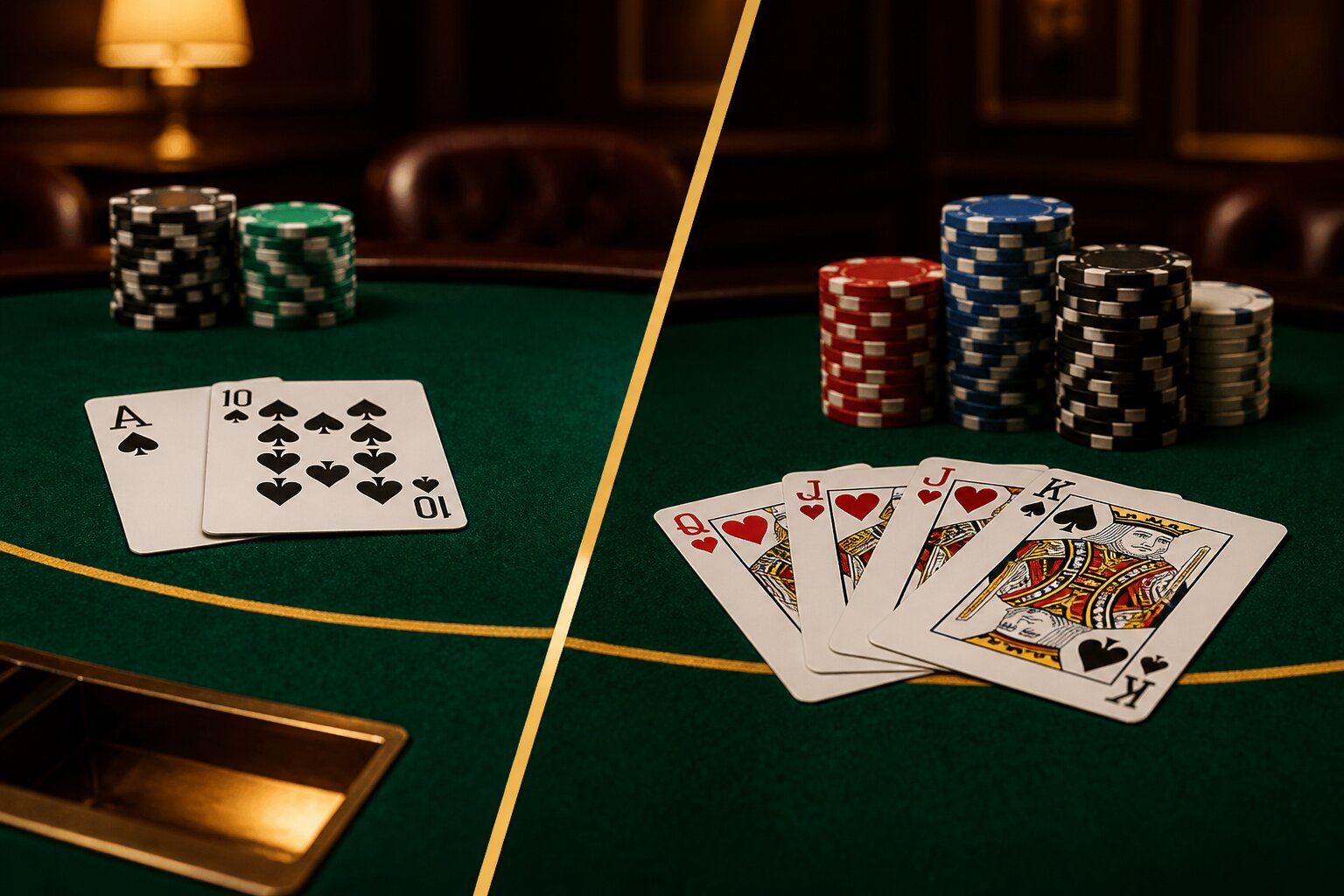
Ever sat down at a casino table and wondered if blackjack is just another form of poker? You’re certainly not alone—many people get these two popular card games mixed up.
Both games use standard playing cards and involve placing bets, but the ways they work, who you compete against, and how you win differ substantially. If you want to pick the best table for your style, a clearer look at those differences helps.
Read on to see how each game plays out, why they feel so different at the table, and which might suit you better.
What Is Blackjack?
Blackjack is a card game where the primary aim is to reach a hand total as close to 21 as possible without exceeding it. Numbered cards count at face value, face cards are worth 10, and an Ace can count as either 1 or 11. Players receive two cards and make decisions—typically to take another card or keep their total—based on the dealer’s visible card and the state of their own hand.
The critical distinction in blackjack is that each player is competing with the dealer rather than with other players at the table. Decisions are made quickly within each round, and special options such as doubling or splitting can appear depending on the variant being played. Common versions include European and American styles, and some tables offer additional rule tweaks that affect strategy and payouts.
Because rounds are short and the rules are focused on numerical totals, blackjack tends to attract players who like fast-paced play and clear, immediate outcomes. Next, we’ll look at poker, which takes a rather different approach to winning and interaction.
What Is Poker?
Poker is a family of card games where players compete against each other to win the pot formed by the bets placed during a hand. Popular varieties include Texas Hold’em, Omaha, and Seven-Card Stud. Unlike blackjack, poker prizes not only the value of the cards but also how those cards are played through betting and psychological play.
Hands are built from combinations of private and, in some variants, community cards. Betting rounds give players opportunities to shape the outcome by checking, calling, raising, or folding. Skill comes through in choosing when to push others out of the pot, when to conceal strength, and how to adjust to opponents’ tendencies.
Poker rounds are generally longer and more interactive than blackjack, with a much greater emphasis on reading other players and managing the size of the pot. With that in mind, the next section compares gameplay features that shape what each game feels like at the table.
How Do Blackjack and Poker Compare?
At first glance the similarities are obvious: cards, chips, and a table. But the structure, objectives, and social dynamics create very different experiences that can suit different personalities and occasions. While both games are played in casinos and at home, the pace, focus and types of decisions players face vary widely, shaping the overall feel of each activity.
Gameplay Structure and Objectives
Blackjack is result-focused in each short round: the objective is to have a higher total than the dealer without going over the limit. Each hand is resolved quickly, and players typically make isolated choices about taking more cards or standing pat based on a limited set of options. The immediacy of results means decision-making is often tactical and centred on the current hand rather than on long-term manipulation of other people.
Poker revolves around forming the best hand or using betting to force opponents to fold, with several betting rounds allowing strategy to unfold over time. Decisions in poker are layered: players consider not only the cards but position, pot odds and the likely intentions of opponents. The unfolding of several rounds of betting creates a narrative across a hand, where earlier choices influence later opportunities and psychological dynamics play an important role.
Number of Players and Interaction
Blackjack places each player in their own contest against the dealer, so table interaction is limited. Conversations and minor social exchanges happen, but the game mechanics do not require players to influence each other, and shifts in play tend to be individual. This structure makes blackjack well suited to players who prefer a more solitary focus while still enjoying a shared environment.
Poker is intrinsically social and competitive; every action affects the other players, and part of the skill set is influencing what other people do. Bluffing, reading tells and altering bet sizes to shape opponents behaviour are core elements. Because every wager can change the incentives at the table, poker rewards long-term thinking and subtle interpersonal strategies in ways that blackjack generally does not.
Card Values and Scoring
Scoring in blackjack is a simple arithmetic matter of totals, while poker relies on a ranked hierarchy of hands—pairs, straights, flushes, and so on. In blackjack the numerical aim is clear: get as close as possible to the limit without going over, and beating the dealer depends largely on the comparative totals and a few rule variations.
In poker, the relative strength of combinations and the timing of bets determine success far more than raw totals do. A weak hand can win against stronger hands if played cleverly, and a strong hand can lose if betting lines are misjudged. The emphasis on relative ranking and situational pressure makes poker a deeper strategic game in terms of psychological and probabilistic considerations.
With those differences clear, it helps to examine how the rule sets themselves steer play and strategy. Each game's rules create incentives that shape typical decisions, and understanding those incentives is key to appreciating why the two games feel so different even though they share a common deck.
Are the Rules of Blackjack and Poker Similar?
Rules create the character of a game, and blackjack and poker have fundamentally different rule frameworks. Blackjack rules govern card values, when additional cards may be taken, and special options such as splitting or doubling. The dealer follows a fixed protocol, which gives players a predictable opponent.
Poker rules vary by variant but commonly include a sequence of deals and betting rounds, limits on bets depending on the format, and a final showdown when more than one player remains. The rules intentionally allow players to influence the outcome by betting, folding, or bluffing.
While both games require an initial stake from players, in poker the flow of bets is central to the contest; in blackjack the single wager placed at the start of a round is resolved against the dealer’s hand. This difference in betting dynamics leads to contrasting skill sets and table tempo, which we’ll explore next when considering how wins are decided.
How Are Wins Determined in Each Game?
In blackjack, outcomes are settled at the end of each hand by comparing a player’s total with the dealer’s. If a player’s total exceeds the dealer’s without going over the limit, the player wins the hand; exceeding the limit results in an immediate loss. There are also ties where the stake is returned, and certain hands—such as a natural 21—can carry special payouts.
Poker outcomes are determined either when all other players fold or at a showdown where the remaining hands are compared according to the game’s hand-ranking rules. Betting behaviour can cause a player to win without showing cards, which makes psychological elements and pot control as decisive as the dealt cards themselves.
These different win conditions help explain why some people prefer the steady rhythm of blackjack while others are drawn to the strategic depth of poker. Next, we’ll consider why the two games are often mixed up.
Why Do People Confuse Blackjack and Poker?
The confusion stems largely from shared surface features. Both games use standard cards, appear in the same casino spaces, and involve placing money at stake. To someone unfamiliar with each game’s mechanics, the visible actions—shuffling, dealing, stacking chips—can look similar enough to blur the distinction.
Media portrayals and casual conversation also lump casino games together, which reinforces the idea that one might be a version of the other. In reality, the core aims, social interaction, and technical rules set them apart in meaningful ways that affect how they are played and enjoyed.
Having unpacked why the mix-up happens, the following section looks at how these games fare in the UK in terms of popularity.
Which Game Is More Popular in the UK?
Both blackjack and poker have widespread appeal in the UK, but they attract different audiences. Blackjack’s shorter rounds and straightforward decisions make it popular among casual players and those seeking a brisk session. Poker’s appeal lies in its layered strategy and the community built around tournaments and regular play.
Live poker events and televised tournaments sustain a dedicated player base, while blackjack remains a reliable choice on most casino floors and online tables. Surveys and industry data typically show broad participation in both games, with player preference often reflecting whether someone seeks rapid play or a deeper strategic challenge.
Understanding these distinctions can guide where to spend time at the casino or what to try next, and the final section brings those ideas together.
Conclusion: Understanding the Distinctiveness of Blackjack and Poker
Blackjack and poker share a place in casino culture but provide distinct experiences. Blackjack centres on fast decisions against a dealer and clear numerical objectives, while poker emphasises interaction, layered strategy, and the influence of betting on outcomes.
Knowing these differences helps set expectations and choose the game that suits your style. Read the specific rules of the table you join, manage stakes within personal limits, and focus on enjoying the play rather than chasing outcomes. With those points in mind, you can appreciate what each game offers and make the most of your time at the table.
**The information provided in this blog is intended for educational purposes and should not be construed as betting advice or a guarantee of success. Always gamble responsibly.