
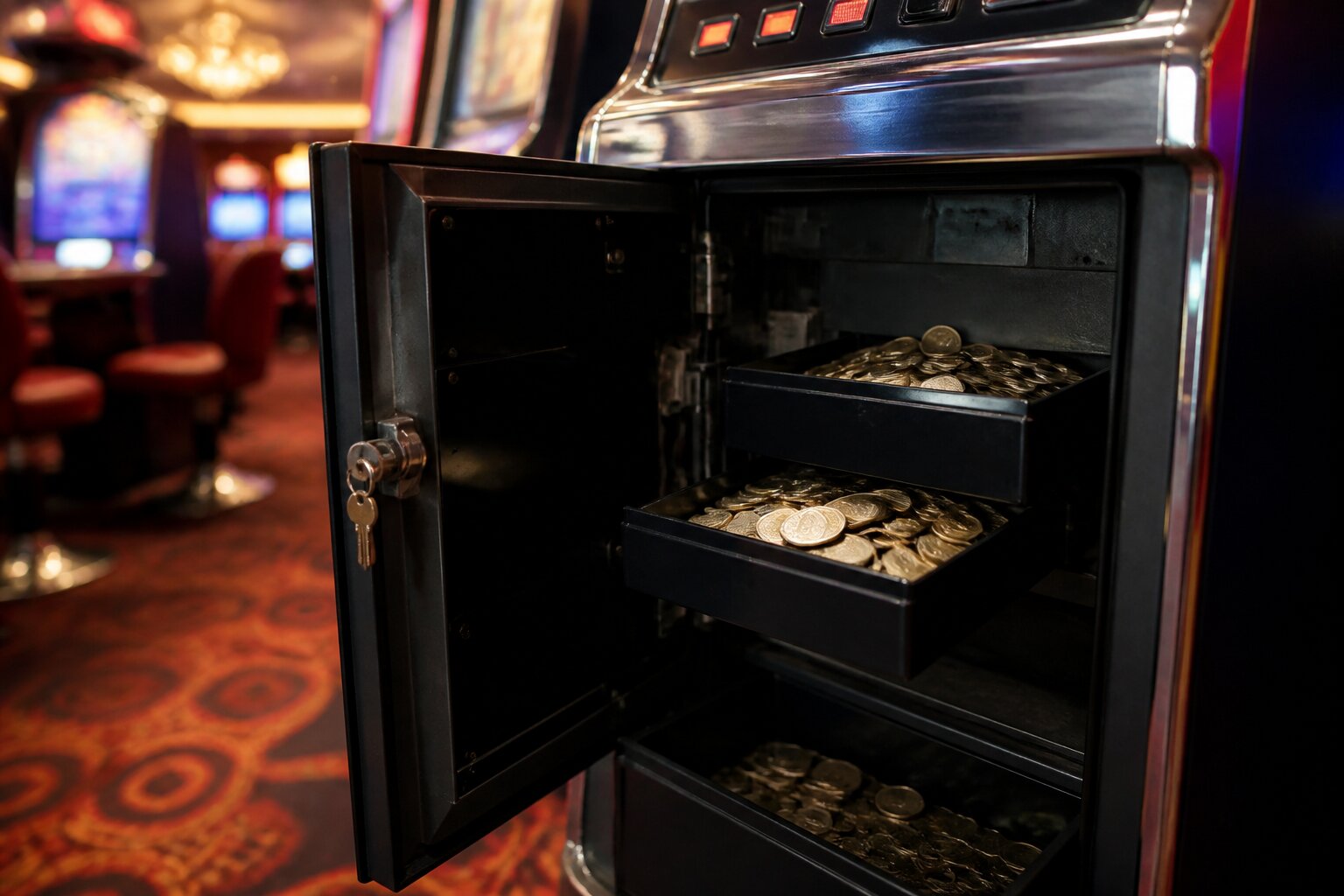
Ever wondered just how much cash a slot machine can actually hold? It’s a question that comes up a lot, whether you’re a casual player or someone who spends a lot of time around the gaming floor.
There’s more to the answer than the size of the cabinet. How a machine stores coins and notes, the way payouts are handled, and regulation all shape how much money sits inside at any one time.
This article walks through the mechanics and the rules, explaining what determines capacity, how payouts are controlled, and what limits operators must follow.
What Determines a Slot Machine’s Cash Capacity?
A few clear factors decide how much money a slot machine can contain. The most obvious is physical space: larger cabinets can house bigger cash storage units, while compact models have far smaller hoppers and note boxes. Inside, manufacturers fit secure containers specifically sized for the machine’s expected throughput.
Technology and design choices change the picture too. Older machines were built to hold large quantities of coins for payouts. Modern machines increasingly accept and dispense banknotes via secure bill validators, or avoid storing much physical currency at all by issuing printed tickets or electronic vouchers. That means two machines of the same size can have very different real-world capacities depending on how they’re configured.
Security and operational procedures also shape capacity. Operators plan routine collections so machines are emptied before they reach a set threshold. This reduces the amount of cash on the floor and limits risk from theft or mechanical failure. In short, capacity is the result of physical design, chosen payout method, and the venue’s cash-handling policies.
How Are Coins and Notes Stored Inside Slot Machines?
Coin and note storage are handled by distinct systems built for safety and reliability. Coins sit in a coin hopper: a robust, mechanical compartment engineered to feed coins out for payouts and to hold any inserted coins. Hoppers are designed to cope with repeated use and heavy flows in busy venues.
Banknotes go into a separate secure chamber after passing through a validator that checks authenticity. Validated notes are pulled into a locked box inside the machine, accessible only to authorised staff during scheduled collections. Where machines issue printed tickets or electronic credits, the amount credited replaces a need to store large sums of physical cash.
All of these components are subject to regular maintenance and checks. Mechanical parts wear, note validators need calibration, and locked cash boxes are inspected under strict procedures to make sure counting and removals are accurate and auditable.
How Do Slot Payouts Work?
Payouts are governed by software and mathematics, not by how much cash is visible in the machine. At the core of each game sits a random number generator (RNG) that determines the result of a spin. That randomness is what ensures each play is independent of previous or future plays.
Alongside the RNG, every game has a published return to player (RTP) percentage. RTP is a long-term average indicating what proportion of stakes is returned to players over time; for example, a 95% RTP means that across a large number of spins £95 out of every £100 wagered would be returned, on average. RTP helps players compare games, but it should not be read as a short-term guarantee.
Regulation requires that game maths and RTP figures are transparent and auditable, ensuring fairness. Payouts are executed according to the game’s rules, with any cash paid from the machine’s available funds or by electronic settlement where ticketing systems are used.
What Is the Maximum Jackpot a Slot Machine Can Pay?
Maximum jackpots are set within regulatory frameworks. Machines are classified into categories, and each category has limits that determine things like maximum stake and top prize. These limits mean that the largest payouts are tied to the machine’s category rather than how full it is.
In the UK, category classifications are used to differentiate machines found in arcades, pubs, clubs and casinos. Higher-category machines in licensed venues can offer larger jackpots than lower-category models, but every machine operates under the constraints imposed by licensing authorities to keep gaming within defined bounds.
These controls are designed to ensure consistency across venues and to protect players by preventing unexpectedly large or unregulated exposures. The precise top prize for any given machine will therefore depend on its legal category, the licence held by the venue and the rules set by the regulator. Online slots and linked progressive networks are also subject to regulatory limits, so their maximum payouts reflect the same framework of oversight.
How Often Are Slot Machines Emptied?
Collections follow a predictable rhythm based on venue traffic and internal security policies. In quieter venues, machines may be emptied less frequently; in busy casinos they are typically checked and cleared daily or more often to prevent excessive accumulation. Frequency often increases during busy periods, such as weekends or special events, to reduce the chance of jams and to limit the amount of cash held in any one machine.
The schedule balances operational efficiency with safety. Regular emptying helps keep machines functioning correctly, since overfilled hoppers or jammed note boxes can lead to mechanical faults. It also reduces the risk associated with transporting larger sums of cash and helps maintain a smooth experience for players.
Only authorised personnel carry out removals, and collections are managed under strict procedures, for example:
- staff operate under a dual control system so more than one person is present during collections
- cash is placed in sealed, tamper-evident containers
- movements are recorded, logged and subject to regular audit
- CCTV and other monitoring systems provide oversight during the process
The process is designed to be discreet and secure so that cash handling does not disrupt play or create risks. Staff receive training on safe handling and on reporting any irregularities, and venues maintain clear records to demonstrate compliance with security and regulatory requirements.
Are There Legal Limits on Slot Machine Holdings in the UK?
Yes. Regulations set maximum amounts that machines may hold and require operators to follow specific rules for managing cash and recording any removals. These legal requirements aim to reduce the risk of theft, fraud and accidental overfilling, and to promote consistent standards across the sector.
Operators must also keep cash securely stored and ensure that collection and handling follow defined procedures. Common measures include sealed collection devices, controlled access to holding areas and limits on how long cash may be kept on site before banking.
Compliance typically involves a number of ongoing tasks:
- scheduled checks of machines and cash storage;
- clear, contemporaneous record-keeping of collections and removals;
- procedures for staff who handle cash, including segregation of duties and authorisation processes.
Regulatory oversight includes routine audits and inspections to verify that operators meet their obligations, and breaches can lead to enforcement action or licence conditions. If you need detailed legal guidance, consult the licensing authority’s publications, which explain the full rules and any recent updates.
Does Having More Money Mean Higher Payouts?
The idea that a machine containing more cash is more likely to pay out is incorrect. The level of money inside a machine is unrelated to the game’s maths or the RNG that decides outcomes. A machine could be full yet pay nothing for a long stretch, or it could pay a large prize soon after being emptied—the two are not connected.
Myth: Do Full Machines Pay Out More Frequently?
This persistent myth comes from how humans search for patterns. In reality, each spin is independent: the machine’s internal software determines outcomes, and stored cash only affects how a venue manages payouts physically. Because machines often issue tickets or electronic credits for larger sums, visible coin or note levels are an unreliable guide to anything about future results.
If you’re thinking about how to approach play, focus on understanding a game’s RTP and volatility rather than how much money you can see inside a machine. Those factors genuinely influence the nature of returns over the long term.
If you ever feel concerned about your play, support is available from professional services. We encourage measured play and sensible money management so time at the machines stays an enjoyable activity rather than a source of stress.
This wraps up the key facts about how much money slot machines hold and how payouts are handled. Armed with this information, you’ll have a clearer view next time you watch a machine in action.
**The information provided in this blog is intended for educational purposes and should not be construed as betting advice or a guarantee of success. Always gamble responsibly.