
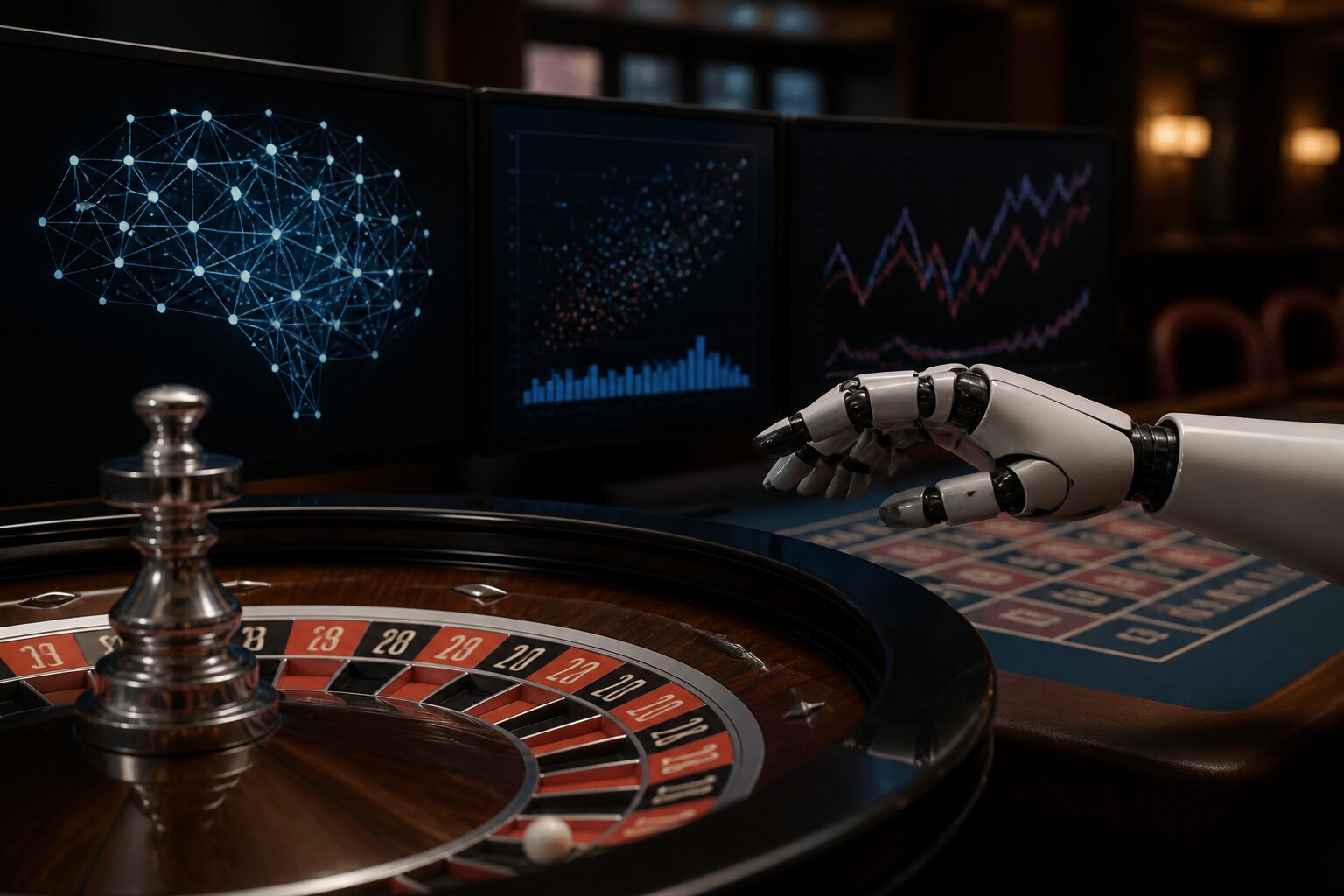
From Hollywood films to high-tech forums, the idea of beating the roulette wheel with artificial intelligence and clever algorithms sparks endless fascination. Could a machine possibly outsmart a game designed around fixed probabilities and regulated fairness?
With rapid advances in machine learning and automated bots, more people are asking whether computers can really crack roulette. Before trusting a bankroll to a clever system, it helps to understand what is technically possible, what is legally allowed, and where the real limits lie.
This article unpicks the myths and facts, explains how roulette operates in different settings, and shows why prediction attempts run into practical and regulatory walls. Read on to see where AI fits into the picture and what that means for players.
How Does Roulette Work Online and in Casinos?
Roulette appears in two main forms: the physical wheel in a casino and the digitally generated spins found online. In a land-based casino, a croupier spins a physical wheel and launches a ball. The final resting place of the ball is determined by the mechanical motion and many tiny physical variables, such as angular momentum, friction, and the precise point where the ball loses speed.
Online roulette generates outcomes with a Random Number Generator, a software process that produces results which are statistically independent and unpredictable. Reputable operators have these systems tested by independent laboratories to ensure the outcomes meet regulatory standards for randomness and fairness.
A key distinction between the two is where unpredictability comes from. In a casino it is physical motion and small mechanical variances. Online it is cryptographic and algorithmic randomness implemented and audited to maintain independence between spins. Both environments are overseen by regulators who require that games cannot be manipulated or predicted, which makes it hard for any external system, including AI, to gain a reliable edge.
What Is AI and Machine Learning in Gambling?
Artificial intelligence refers to computer systems that can carry out tasks that would typically require human intelligence, and machine learning is the part of AI that learns patterns from data. In the gambling sector these technologies are used for operational purposes that help both players and operators rather than to beat games.
Common, legitimate uses include personalising the user interface to match player preferences, detecting fraud by spotting unusual transaction patterns, and identifying risky playing behaviour so that operators can offer support. These applications improve security and player protection while remaining within regulatory frameworks.
Attempts to use AI to predict or manipulate game outcomes fall outside acceptable uses and breach operator terms and regulatory rules. Such systems are not part of the regulated toolkit and are treated as attempts to gain an unfair advantage, which brings both technical and legal consequences.
Are Prediction Bots Legal or Effective in Roulette?
Using prediction bots in an attempt to get an advantage in roulette is not permitted at licensed online casinos and is unlikely to be effective. Operators monitor play to detect abnormal patterns and unusual betting behaviour, and any unauthorised automation that tries to influence outcomes typically contravenes site terms and regulatory requirements.
Casinos use surveillance and algorithmic monitoring to flag accounts that display evidence of bot usage. Penalties for confirmed use can include suspension, confiscation of funds, closure of accounts, and sharing of offender details with other operators. These safeguards are in place to protect the fairness of play for everyone.
Can bots outsmart Random Number Generators? The short answer is no. RNGs in regulated online games are explicitly designed to produce independent outcomes with no exploitable sequence. The algorithms and their implementations are tested to ensure there are no predictable patterns, so external systems cannot infer future spins from past results. Detection systems and contractual rules make practical use of bots both risky and unlikely to succeed.
Limits of AI in Predicting Roulette Outcomes
The mathematical structure of roulette sets hard limits that technology cannot change. On a European wheel there are 37 possible outcomes, which means the probability of any single number is 1 in 37. Those odds do not shift over time or because of how previous spins have fallen. Machine learning models are powerful when they can learn from meaningful, repeating patterns or from environments where past events influence future ones. Roulette provides neither.
Regulated online games produce statistically independent results, so the core assumption that would allow AI to improve predictions is absent. Even where physical wheels are involved, casinos maintain equipment and procedures to avoid any measurable bias. The house edge is built in through the payout structure; for example, the single-number payout is set slightly below the fair odds, which produces a long-term advantage for the operator. That mathematical advantage cannot be removed by algorithms.
By contrast, AI demonstrates clear strength in games where memory, strategy or incomplete information matter. Examples include games that reward pattern recognition over many events or where adaptive play can alter an opponent’s behaviour. Roulette presents a different set of rules where those strengths do not transfer, so performance expectations for prediction systems must remain low.
Why Is Roulette Hard for AI to Predict?
Roulette is engineered for independence and fairness, making prediction exceptionally difficult. Whether the outcome is produced by physical motion or by an RNG, every spin is intended to be a fresh event unaffected by history. That eliminates the serial correlations machine learning typically exploits.
The house edge is a concrete mathematical feature of the game. For instance, a single-number bet on a European wheel pays out at odds that leave the operator a small percentage advantage. Over many plays this margin is what determines long-term results, and no prediction system can change those mathematics.
Physical wheels add variability through many tiny influences such as wheel balance, ball wear, and environmental conditions. Casinos reduce their significance through maintenance and testing so that any tiny biases are corrected. Online systems deliberately prevent patterns by design and by independent auditing. Together these measures close the practical avenues through which AI might otherwise seek to gain insight.
Myths and Misconceptions About AI Roulette Systems
There are persistent ideas that AI can somehow guarantee wins or that bots can exploit so-called hot and cold numbers. These claims misunderstand both the mathematics of the game and how machine learning works. In roulette every number has the same chance on each spin, and there is no mechanism within properly designed games for a system to convert past results into reliable future predictions.
Another common misconception is that an AI could break or influence an RNG. Certified RNGs and their surrounding systems are tested and secured against tampering and external inference. Claims that a bot can undermine such systems ignore the technical and regulatory protections operators have in place.
It is also misleading to treat anecdotal runs or short-term wins as evidence that a system works. Random sequences will occasionally produce streaks that look meaningful to a human observer, but pattern-seeking behaviour is a known cognitive bias and not proof of predictive power. Understanding why these apparent patterns are not predictive is essential for setting realistic expectations about AI in roulette.
Ethical and Responsible Gaming Considerations
All gambling activity should be approached with clear boundaries and informed decision making. No strategy or technology can reliably generate profit from roulette, and framing play as a way to make money risks harmful behaviour. Operators provide tools such as deposit and loss limits to help people manage how they play and these are there to support users in keeping play within affordable and enjoyable limits.
If gambling becomes stressful or starts to interfere with daily life, it is important to seek help from specialist support services that provide confidential advice. Maintaining a view of roulette as entertainment rather than income helps preserve enjoyment and reduces the chance of harm.
Operators and regulators prioritise fair play, transparency and protection for players. That framework shapes how technology is used in the industry and why unapproved attempts to influence outcomes are both unsafe and unacceptable. With that context in mind, players can make better decisions about how and why they choose to play.
Play Online Casino Games at Pay By Mobile Slots
We welcome you to explore our site and enjoy the experience of playing casino games in a friendly, relaxed environment. You’re always free to play at your own pace, with no pressure.
**The information provided in this blog is intended for educational purposes and should not be construed as betting advice or a guarantee of success. Always gamble responsibly.