
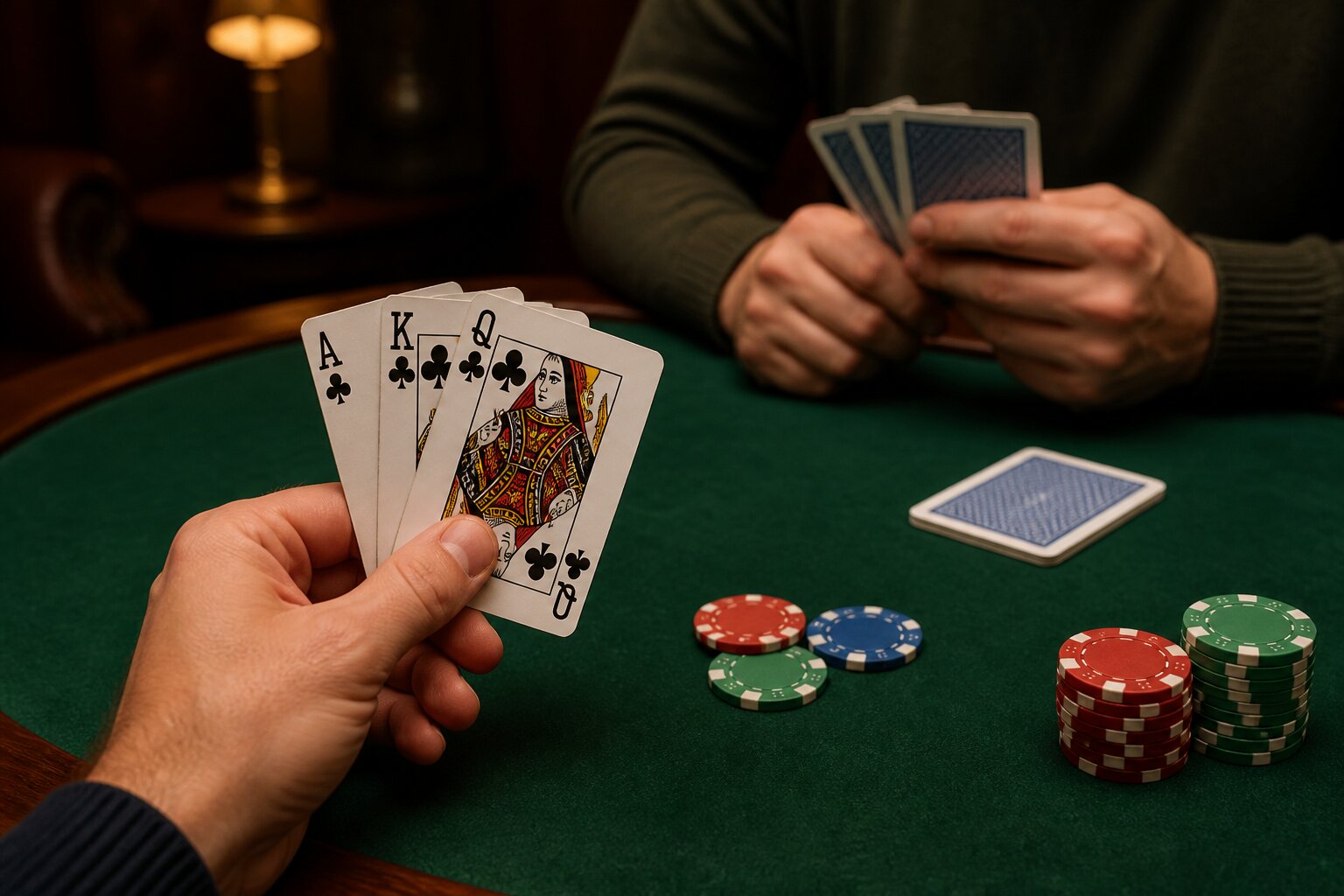
Looking for a classic card game that's quick to learn and plays at a lively pace? 3 Card Brag has been popular in the UK for generations: rounds are short, the rules are straightforward, and strategic choices matter every hand.
Whether you’re brand new or need a clear refresher, this post explains how the game works and how hands are ranked. An example hand near the end shows the stages of a round so you can see the rules in practice.
Play is for adults only. If betting for real money, set limits before you start and only wager what you can afford to lose.
What Is 3 Card Brag?
3 Card Brag is a British card game where each player aims to hold the strongest three-card hand at the table. It shares some features with poker—such as betting and hand comparisons—but has its own distinct hierarchy of hands and a faster tempo. The core appeal is the balance between decision-making and chance, which keeps each round engaging.
The game dates back to the 18th century and is commonly played in homes and informal settings. Variants exist, including versions with special payouts for certain hands or slight rule changes, but the classic form described here is the most widespread. Next, the basic rules explain how a round is set up and resolved.
Basic Rules of 3 Card Brag
3 Card Brag uses a standard 52-card deck with jokers removed. Each player receives three cards face down and keeps their hand private unless they choose to “see” it. Before dealing, players agree an ante that every participant places into the pot, establishing what’s at stake.
Betting proceeds in turn. A player can fold and leave the round, call by matching the current stake, or raise to increase the stake. Players may also bet blind (without looking at their cards) or seen (after checking them). Blind bettors usually face lower minimums while seen bets are typically higher; this distinction influences how the betting unfolds.
A round ends when all but one player has folded or when remaining players have matched the highest bet and reveal their hands. The strongest hand, by the specific Brag rankings, wins the pot. If two players have equivalent hands, the usual tie-breakers apply and the pot may be split in rare cases.
How Do You Play 3 Card Brag?
Playing 3 Card Brag is straightforward once the setup and betting sequence are understood. It helps to agree table rules—number of players, ante, and the relative minimums for blind and seen bets—before cards are dealt, so everyone knows the stakes and the flow.
Setting Up the Game
Gather between two and eight players and use a single 52-card deck. Agree the ante, which each player contributes to the pot before the deal. The dealer gives three cards to each participant, face down. Players then choose whether to look at their hand (play seen) or keep it face down (play blind), remembering that the betting structure usually treats blind and seen wagers differently.
Shuffling and dealing are simple, but establishing who acts first (typically the player to the dealer’s left) and the minimums for blind and seen bets avoids disputes and keeps rounds moving.
Betting Rounds & Stakes
After the deal, players take turns deciding how to act. Betting proceeds around the table with options to fold, call, or raise. A blind player might place a lower stake to stay in, while a seen player faces larger minimums; these rules create tension between risk and information.
Bets continue until only one player remains or until all active players have matched the highest wager. If more than one player remains, hands are revealed and compared according to Brag rankings to determine the winner.
Hand Rankings in 3 Card Brag
Knowing the hand hierarchy is essential because Brag uses different priorities from standard poker. Hands are compared by these ranks, from strongest to weakest, and recognising these differences will help you understand betting and showdowns. The order below is what determines the outcome when players compare hands at the end of a round.
The Strongest Hands Explained
The hands, from strongest to weakest, are ranked as follows:
Prial (Three of a Kind)
A prial is three cards of the same rank. In Brag, three 3s are the single strongest prial, then three aces, then down through kings, queens and so on. This unusual ordering means the value of identical sets varies from other games, so recognising prials quickly is important in play.
Prials beat every other hand type, so if you hold one you will usually be in a commanding position. As with all comparisons, suits are irrelevant for prials; only the rank of the three matching cards matters.
Example: Q♣ Q♦ Q♠
Running Flush (Straight Flush)
Three consecutive cards of the same suit form a running flush. A-2-3 of the same suit is the top running flush, followed by K-Q-J and lower sequences. Suits do not rank against each other; the sequence and suit uniformity make this hand powerful.
Running flushes are second only to prials and will beat any run, flush, pair or high card. The ace can be used low in A-2-3 but does not act as a bridge between king and two.
Example: 4♦ 5♦ 6♦
Run (Straight)
A run is three consecutive cards of mixed suits. Ace can play high or low in sequences; A-2-3 occupies a distinct, high-ranking position in Brag hands. Runs are compared by the highest card in the sequence, so a higher top card wins if two players both hold runs.
Runs are stronger than flushes, pairs and high-card hands, but will lose to any running flush or prial. Remember that the suits being different means it is not a running flush.
Example: 9♣ 10♦ J♠
Flush
Any three cards of the same suit that are not consecutive form a flush. When multiple players have flushes, the highest individual cards determine the winner, comparing top cards then the next highest if needed.
Flushes outrank pairs and high-card hands but are below runs, running flushes and prials. Suits themselves do not have an order, so only the card values within the flush matter during comparison.
Example: 2♥ 7♥ 10♥
Pair
Two cards of the same rank with an additional unrelated card. When two players share the same pair, the third card—the kicker—decides which pair wins.
Pairs beat high-card hands but lose to flushes, runs, running flushes and prials. If the pair ranks are equal, the highest kicker wins; if kickers are identical, the pot may be split depending on house rules.
Example: J♣ J♠ 5♥
High Card
Three cards that don’t form any of the above combinations. The single highest card governs which high-card hand is superior, then the next highest if tied.
High-card hands are the weakest and are settled by comparing the top card, then the second, then the third. Ties at this level are uncommon but can occur; house rules determine whether the pot is shared.
Example: A♣ 7♦ 2♠ beats K♠ 10♥ 4♦
What Happens with Tied Hands?
Ties are resolved by comparing the relevant cards for that ranking: prials by the rank of the three, pairs by the kicker, flushes and runs by the highest constituent cards. If the relevant comparison still leaves the hands equal, the next appropriate card is compared until a winner is determined.
Only in extremely rare situations—such as errors or use of multiple decks—will hands be identical in every respect; in those cases the pot is shared. Specific house or venue rules may also set procedures for splitting pots or handling disputes, so it is sensible to be aware of the local rules before you play.
With hand ranks clear, the example hand below shows how betting and comparisons interact in a typical round.
Example of a Simple Hand
Four friends agree a £1 ante and each places their pound in the pot. The dealer deals three cards to every player face down.
One player looks at their cards and sees 9♠, 9♥ and 4♣—a pair of nines. Another plays blind and posts the lower blind bet of 50p. A third player looks and raises to £1, signalling confidence, while the fourth folds.
The pair-holder calls the £1, matching the current bet. The blind player, who had only put in 50p, decides to match the higher stake and adds another 50p. The originally seen player then raises again to £2. The blind player decides to fold at this point; the pair-holder weighs the odds and chooses to call the extra £1.
When both remaining hands are turned over, the pair of nines (9♠ 9♥ 4♣) beats the other player’s pair of eights (8♦ 8♣ Q♠), so the pair-holder wins the pot. The example shows how bet sizes, seen versus blind play, and quick decisions determine each round’s outcome.
Keep to agreed limits and make sure participation is only ever for adults; playing with clear boundaries keeps the game enjoyable. That last example brings the rules and rankings together so you can recognise how a typical round unfolds and what to expect when you take a seat at the table.
Explore Casino Games at Pay By Mobile Slots
Ever thought about discovering a new way to enjoy online casino games? We’d love to welcome you to our site where you can experience all the fun we have to offer.
Getting started is straightforward – simply create your account, make a deposit, and you’re ready to play. We hope you enjoy your time with us at Pay By Mobile Slots.
**The information provided in this blog is intended for educational purposes and should not be construed as betting advice or a guarantee of success. Always gamble responsibly.